False Humility
Article A:
My analogy is this. Think of a policeman. When he goes to work, he doesn’t roll into the station wearing pajamas and telling his colleagues, “Don’t worry guys, I’m still on duty, I just wanted to look humble today.” No, that would be ridiculous. When you’re a police officer, you put on the full uniform, the badge, the belt, everything. Why? Because the uniform isn’t about your personal comfort or your personal style. It’s about the office you represent. The authority isn’t in the man, it’s in the office entrusted to him.
Now take that principle and apply it to the presbyterate. A priest doesn’t vest beautifully because he wants to look fancy. He vests because he has been ordained into a sacred office that deserves visible honor. The beautiful vestments don’t glorify his personality, they glorify the priesthood of Christ working through him. That’s why the traditional vestments are beautiful, symbolic, and rich. They point to something higher than the man himself.
And honestly, it’s far more humble for a priest to submit to the tradition of the Church, put on the full vestments, and disappear into the office, than to say, “Well, I want to express my own simplicity, so I’m going to strip things down and be more casual.” That is actually the opposite of humility. True humility is respecting the office, not reshaping it to match your personal aesthetic.
When you wear what the office requires, you show that the office is bigger than you. And that is exactly how the presbyterate should be treated.
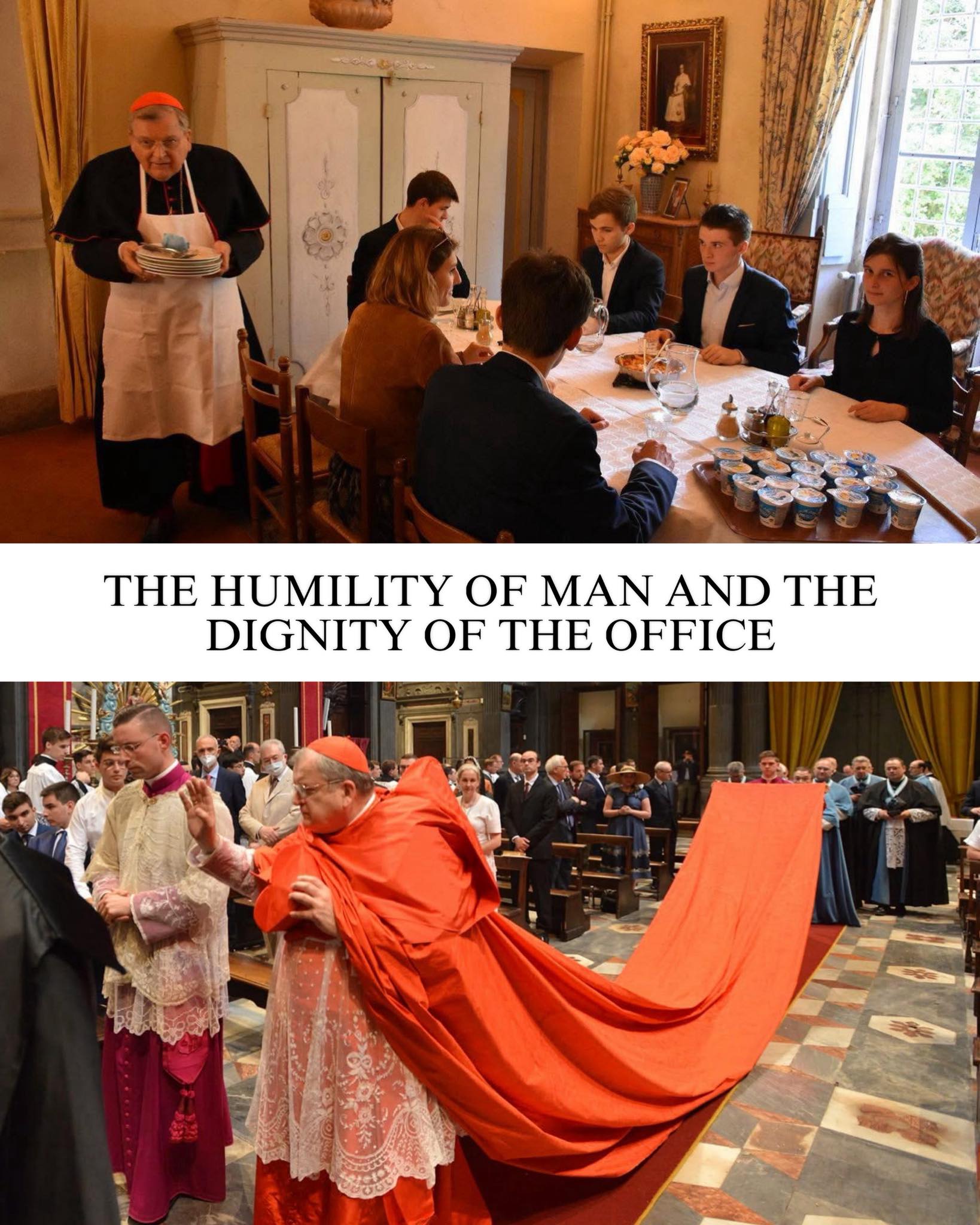
And in this photo we see exactly that point lived out by Cardinal Burke. The one on top shows him in his basic cassock, wearing a kitchen apron and serving plates to his guests. Simple, ordinary, just a man doing normal hospitality. But the one on the bottom shows him inside the church processing at mass Mass in full ceremonial dress. Full regalia, the whole tradition, he even wears the cappa magna. That is not vanity, that is the office. The man disappears and the priesthood of Christ takes over. That is how it should be.
Article source: Altare Dei
Contrast this with the false humility of pope Francis (Bergolio).
Article B:
A few months ago, a photo started circulating online showing Pope Benedict XVI and Pope Francis sitting side by side. It went viral because it looked like a perfect contrast: Benedict seated on a magnificent golden throne, wearing richly embroidered vestments, a golden pectoral cross, and even a red carpet beneath him. Francis, meanwhile, sits on a plain wooden chair, wearing only his white cassock, black shoes, and a silver pectoral cross. The caption boldly declares:
“Francis refused to wear any personal garment made of gold, including his pectoral cross. He wore one made of silver or wood instead. He had his throne replaced with one made WITHOUT GOLD, the Pope of the people.”
Now that sounds powerful. It plays into a narrative people love, the “simple pope vs the fancy pope.” But as with most viral Catholic content, this calls for serious clarification. Much of the modern confusion comes from a misunderstanding of what “simplicity” actually means in Catholic tradition, and, more importantly, what liturgical symbolism is even for.
In Catholic tradition, beauty is not decoration. It is proclamation. It is catechesis in the language of glory. Sacred beauty is not about personal taste or ecclesiastical fashion; it is about reflecting heavenly reality on earth. God commanded Moses to build the Tabernacle with gold, fine linen, acacia wood, precious stones, and priestly vestments “for glory and for beauty” (Exodus 28:2). That is Scripture. That is not medieval “excess.” That is divine instruction.
St. Peter’s Basilica is not covered in marble, gold, mosaics, and priceless art because popes liked to flex wealth. It is built that way because Catholics believe God truly dwells there. The Church has always understood that what we build for God should reflect His majesty. This is why medieval peasants built towering cathedrals while living in tiny homes. They did not put themselves first and God second. They reversed the modern logic entirely.
Likewise, beautiful vestments, golden chalices, incense, chant, and ornate altars are not about glorifying the priest. They are about glorifying the liturgy. They are meant to disappear into the symbolism of Christ the High Priest. The vestments hide the man so the priest can act in persona Christi without distraction.
So when people online interpret a golden throne as somehow “Benedict being lavish,” or a wooden chair as “Francis being humble,” they completely miss the point. The symbols of the liturgy do not exist to express a pope’s personality. They exist to express the Church’s theology. The throne of the Pope is not about Joseph Ratzinger or Jorge Bergoglio. It is about the Chair of Peter, a symbol of Christ’s authority entrusted to His vicar.
This is why assuming that liturgical beauty is “about the man” is actually contrary to humility. If a pope rejects sacred signs because he thinks they “make him look too important,” then, ironically, he is making it all about himself. Instead of disappearing into the majesty of the office, he personalizes the liturgy by imposing his preferences. Real humility submits oneself to the tradition; it does not reinvent it.
When Catholics kiss a bishop’s hand, it is not because they think he is personally holy. It is because those hands are consecrated for sacred duties: to bless, to absolve, to confect the Eucharist. When we bow before the altar, we are not bowing to stone; we are bowing to the place where Christ becomes present. It is sacramental, not personal. Catholicism is incarnational. We use physical signs because Christ used physical signs.
So the same logic applies to the pope’s throne, vestments, mitre, staff, and, yes, even the materials used in his pectoral cross. If simplicity equals holiness, then where do we draw the line? Should the pope sit on the floor? Should he wear burlap? Should Mass be celebrated on a folding table with paper cups? Should we tear down every altar and replace marble with plywood “to show humility”?
Of course not. That is absurd, and yet that is often where modern misunderstandings lead.
A golden chalice does not honor the priest. It honors the Precious Blood. A beautiful altar does not inflate the ego of the celebrant. It proclaims the Real Presence at the center of Catholic worship. Beauty in the liturgy teaches us to look upward, to desire heaven, to remember that the Mass is not a gathering or a performance; it is the unbloody re-presentation of Calvary.
When we reject or downplay sacred beauty, we are not being humble. We are flattening the sacramental worldview and replacing it with personal preferences. We are saying, “My taste is more important than the tradition I inherited.”
This is why Pope Benedict XVI’s throne, vestments, and liturgical choices matter. They were not about Benedict the man. They were about honoring the liturgy and the papal office with the richness and dignity that the Church has always given to God.
So yes, Pope Benedict sat on a golden throne because the Chair of Peter deserves that dignity, not because Benedict wanted gold. His glorious vestments were not personal vanity. They were a continuation of a two thousand year tradition of giving God our very best in worship.
This whole debate has never been about the personal holiness of the pope. It has never been about Benedict versus Francis. It has always been about what the Catholic Church believes the liturgy is.
And at the end of the day, it all comes down to this:
The Mass is for God.
The beauty is for God.
The dignity is for God.
The throne is for the office.
And the office exists for the glory of Jesus Christ.
That is Catholicism. That is tradition. And that is why we give God the absolute best we can offer, not because He needs it, but because we do.
Article source: Altare Dei